Agentic Replenishment and What It Actually Takes
Replenishment is the retail use case where agentic AI generates returns fastest. It is also the case where poor master data becomes expensive fastest. Here is what an ordering agent truly needs before it is allowed to place orders.
July 31, 2026 · approx. 7 Min. read · Jan B. Fischer
Motiv
Contents
Few retail processes are as well suited to AI agents as replenishment. It runs daily, follows rules, and consumes time. An agent that triggers order proposals autonomously takes the load off purchasing from day one. Yet many replenishment agents never make it from pilot to production. They impress in the demo, then a human takes over again.
This article explains why. It traces the data chain behind an ordering decision, identifies where things most commonly break down in practice, and closes with five questions you can use to assess your own organisation — no questionnaire, no consultant, in a single afternoon.
Why is replenishment particularly well suited to AI agents?
Replenishment meets all three conditions for a worthwhile agent deployment: it is frequent, it follows rules, and its outcome is measurable. That combination is rare in retail. Many processes are frequent but unstructured. Others follow rules but occur only once a quarter.
Replenishment means reordering stock before a shelf or warehouse runs empty. Today, a purchasing manager makes that call — the person who determines order quantities and timing. They check inventory levels, sales velocity, and lead times. Article by article, every day. With a range of tens of thousands of items, there is barely a minute to spare per article.
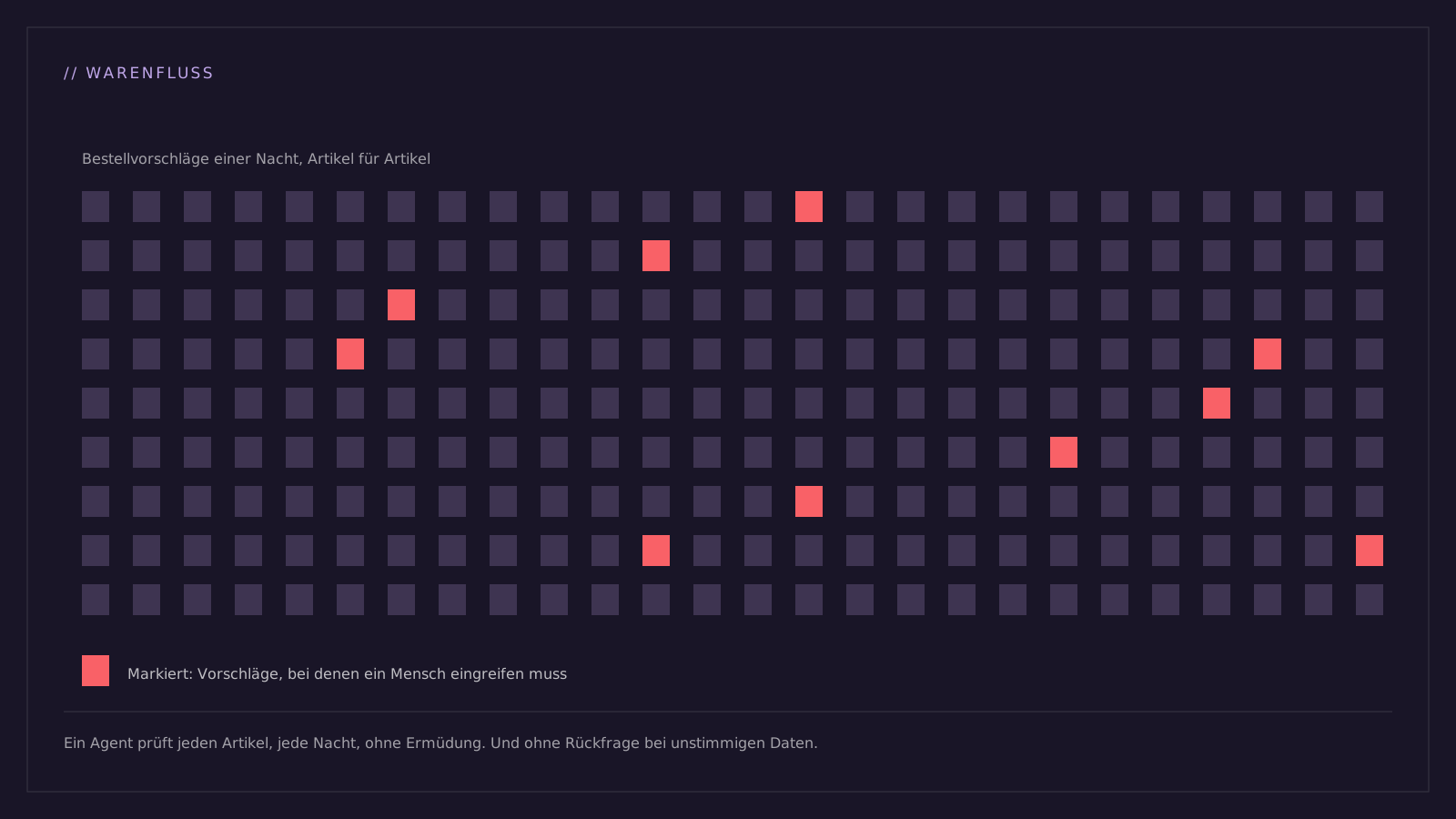
That is exactly where the agent comes in. An AI agent is not just a tool that makes suggestions — it acts autonomously. It checks the same data as the purchasing manager, but for every article, every night, without fatigue. People handle the exceptions; the agent handles the rest. The benefit shows up directly in metrics every retailer already tracks: out-of-stock rate, overstock, tied-up capital, and time spent in purchasing.
The catch only becomes visible on closer inspection. An agent sees only what is in the systems. An experienced purchasing manager notices when a lead time cannot be right, follows up, or quietly corrects it. That kind of correction happens thousands of times a year, and nobody writes it down. An agent does not bring that tacit knowledge with it. It processes what is there — at scale, without asking questions.
How does an ordering agent make decisions?
Every automated ordering decision is built from at least four inputs: current inventory, sales data, lead time, and the supplier's order conditions. If any one of them is missing or wrong, the order will be wrong. The mechanics are that simple — and that unforgiving.
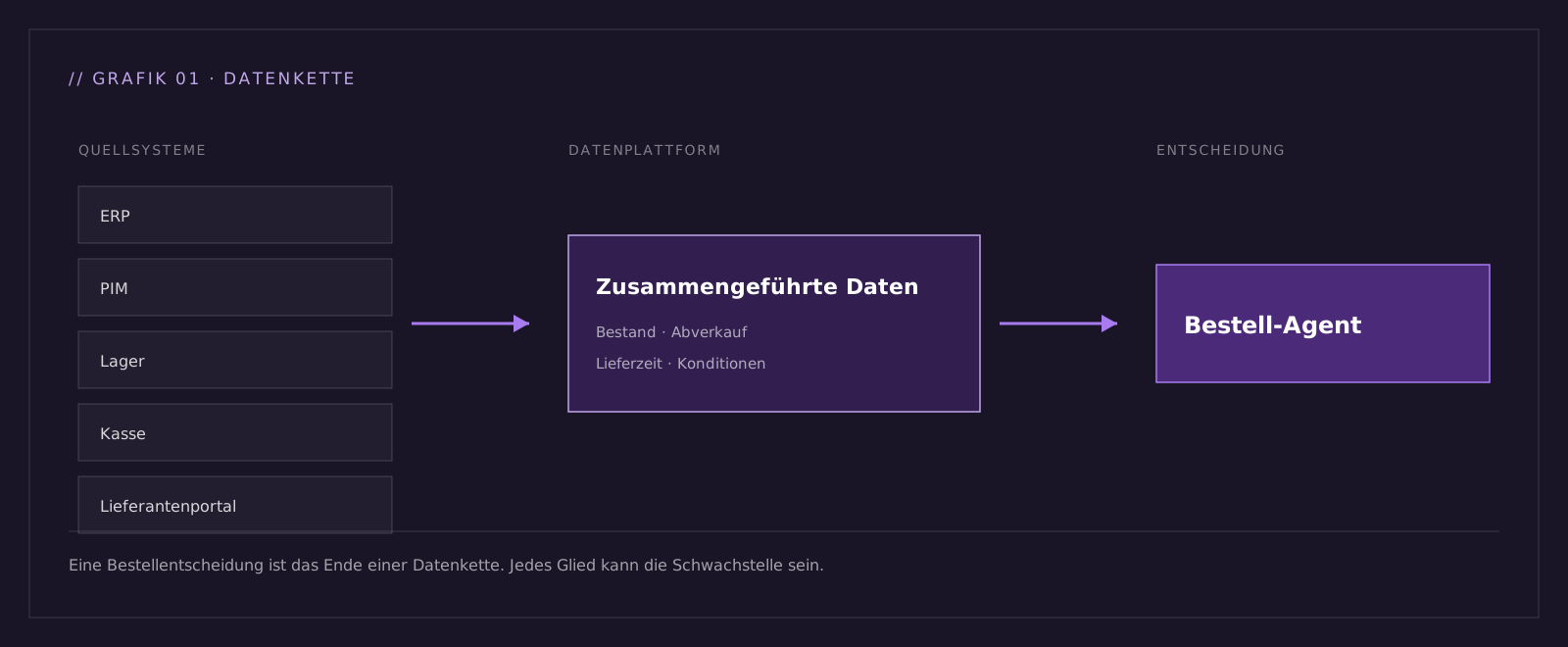
These four inputs live in different systems. Inventory comes from warehouse management and store systems. Sales data comes from the point of sale. Lead times and minimum order quantities are held in the merchandise management system or come directly from the supplier, for example via a supplier portal. A data platform brings everything together, and the agent reads from that consolidated view.
What tends to be overlooked: technically correct data is not enough — it also has to be technically accessible to the agent. It works through interfaces. Excel exports that someone pulls on a Friday never reach it. A lead time that is maintained somewhere but only exists in a spreadsheet on a shared drive does not exist for the agent.
There is one more difference between a pilot and live operations. In the pilot, someone cleaned the data by hand beforehand to make the demo convincing. In day-to-day use, that manual work disappears. The agent encounters the real system landscape, with everything that has accumulated there over the years.
Why do ordering agents fail in practice?
Almost never because of the AI. In the data assessments we conduct in retail, a pattern repeats itself: the bottleneck is in the article master data — the core information held for each article. Three problems come up again and again. The article master is maintained in two systems in parallel, with neither designated as the lead. Mandatory fields such as lead time and minimum order quantity are only partially filled in. And no one is formally responsible for maintenance, so several departments correct things alongside each other.
The research backs this picture. In the KI-Studie 2025 des Handelsverbands Deutschland (HDE), 89.1 percent of the retailers surveyed name high data quality as a relevant success factor for AI projects — and according to the study, it remains the single most important success factor of all. Gartner predicts that more than 40 percent of agentic AI projects will be cancelled by the end of 2027, citing rising costs, unclear benefit, and missing risk controls as contributing factors. A forecast, not a measured result — but one that matches what we find when we look inside system landscapes.
A worked example with fictitious data. A multichannel retailer with 84,312 active articles wants to automate replenishment. A direct measurement in the systems reveals: lead time is maintained for 54 percent of articles, minimum order quantity for 61 percent. For nearly every second article, the agent has to guess or a human has to step in. The pilot confirms this. A purchasing manager intervened in 31 percent of order proposals — in nearly three quarters of those cases, the reason was master data. The full findings are available in the freely accessible sample report.
What is striking about findings like these is the order in which surprises arrive. The people involved are usually aware of their data problems. What they underestimate is the connection to the agent. A gap that ten purchasing managers have lived with for years — compensating for it in their heads — becomes a hard stop for the agent. Automation turns a familiar annoyance into a measurable error. Every night, every article, every order.
What does an ordering agent actually need?
Not a perfect organisation. That is the good news, and it matters more than it sounds. A replenishment agent needs five things in good shape; everything else can be unfinished.

First, clean article master data: maintained lead times, minimum order quantities, and a clear supplier assignment, managed in a single system that holds authority. Second, reliable inventory data, measured by accuracy and freshness. Last night's figures are sufficient for slow movers; for fast-moving ranges, they are not. Third, an automated data flow that delivers numbers to the agent without manual intervention. Fourth, well-organised knowledge of supplier conditions, assortment rules, and seasonal rules — held in a verified source rather than in multiple versions of Excel files. And fifth, controlled operations: a log that makes every decision traceable, clear boundaries on what the agent is permitted to do, and a named person who approves exceptions.
These five points may sound like a lot. In practice, they define the scope of the work. Anyone who knows them does not need to overhaul their entire data landscape before the first agent goes live. It is enough to bring the areas in order that this one use case requires. That is what separates a focused entry point from an enterprise-wide data project that never finishes. How we measure these areas and how the measurement produces a score from 0 to 100 is openly documented on the methodology page.
How can you assess your own readiness?
With five questions you can answer without an external assessment. Set aside an afternoon and bring in the people who work with the data.
- Is there a single system that is the authoritative source for article master data? If two systems are being maintained in parallel, that is the most common root cause of every downstream problem.
- What percentage of your active articles have a maintained lead time and minimum order quantity? If you do not know the number, you do not know your risk. The query takes an hour.
- How current is the store inventory your systems display? Last night's figures work for some ranges. For fast-moving ones, they do not.
- Where do supplier conditions and assortment rules live? If the answer is Excel, an agent cannot use them reliably.
- Is there a named person responsible for the article master? Without clear ownership, any clean-up effort will deteriorate again within a few months.
Anyone who can answer all five questions confidently is closer to a productive agent than most. Anyone who hesitates on two or more has most likely already found their bottleneck. That is not a reason to abandon the project — it is a signal about where to focus first: close the gap, then deploy the agent. The other way around gets expensive.
What is the honest next step?
Measure, do not estimate. Whether your data is sufficient for an ordering agent can be established with evidence drawn directly from your systems, using an open standard, in three weeks. The result is a reliability score, a named bottleneck, and an action plan you can execute without external help. The outcome is open: if your data foundation is strong, that is the green light for the agent. If it is not, you will know what to do first — before you become part of the cancellation statistics.
How the assessment works in detail — including all criteria and formulas — is set out on the methodology page. What a completed report looks like is shown in the sample report. Both are freely accessible, no form required. Read them before you start your next pilot.
Sources
| Source | What it says |
|---|---|
| HDE & Safaric Consulting · KI-Studie im Handel 2025 | |
| Gartner · Prognose zu agentischen KI-Projekten, Juni 2025 | |
| prodct · Beispiel-Report ACME Inc. (fiktive Daten) |
Related articles.
Why AI Agents Fail in Production
Impressive in testing, switched off in practice. The most common reasons AI agents don't survive day-to-day operations — and how to spot the risk before you invest.
approx. 7 Min. read · August 2026 Read the article →What Data Does AI Need? Five Questions Before You Start
AI doesn't need perfect data — but it does need the right data in the right condition. Five questions to assess whether your data is sufficient for an AI use case. Before you bring anyone in.
approx. 8 Min. read · August 2026 Read the article →All insights on data, agents and production readiness
The full collection. Filtered by flow of goods, agents, use cases, data foundation and method.
Overview Go to insights →